
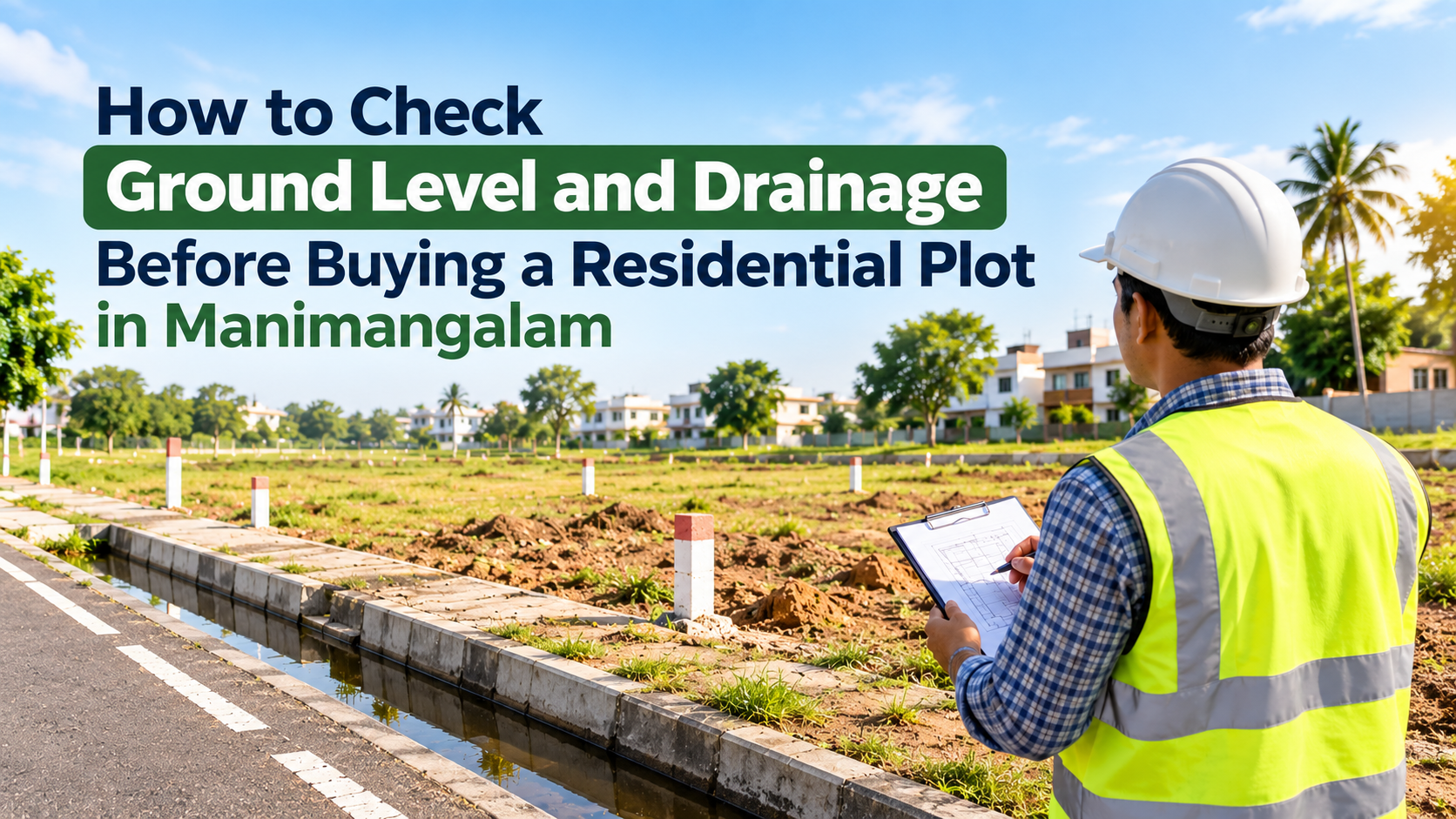
Buying a residential plot is an important decision, especially when you are planning to build an independent home in the future. While buyers often focus on location, price, road access and plot dimensions, two important factors can sometimes receive less attention: ground level and drainage.
A plot may appear suitable during dry weather, but its condition can change significantly during heavy rainfall. Low-lying land, poor drainage or differences between the plot and surrounding road levels may create additional expenses when construction begins.
For buyers exploring residential plots in Manimangalam, understanding these factors before purchasing land can help avoid unexpected complications and support better long-term planning.
The ground level of a residential plot refers to the elevation of its surface compared with nearby roads, neighbouring properties and surrounding terrain.
Drainage refers to how rainwater moves away from the land and whether water can accumulate within the property.
These two factors are closely connected.
For example, a plot positioned lower than the adjoining road may receive runoff during rainfall. Similarly, a plot with an uneven surface may develop areas where water collects.
Before purchasing land, buyers should assess:
Understanding these conditions can help buyers estimate potential site preparation requirements before construction.
One of the first things to observe during a site visit is whether the residential plot is higher or lower than the adjoining road.
A plot that sits noticeably below road level may be more exposed to runoff, depending on the road's slope and drainage arrangements.
However, a plot being higher than the road does not automatically guarantee protection from waterlogging.
Check the following:
If the height difference is difficult to assess visually, consult a qualified surveyor for accurate measurements.
A professional level survey can provide more reliable information than estimating elevation by sight.
Residential plots are not always perfectly level.
Some have a gentle slope, while others may contain uneven surfaces or depressions.
A slight slope can influence the direction in which rainwater travels.
During your inspection, look for:
Do not assume that every uneven plot requires extensive levelling.
The appropriate solution depends on the site's existing conditions and the proposed construction.
An engineer can assess whether grading, filling or another drainage measure is necessary.
A residential plot may look dry and well-maintained during summer, making it difficult to identify drainage concerns.
Visiting the site after rainfall can provide additional information.
If possible, inspect the location after a period of significant rain, when it is safe to do so.
Observe whether:
A single visit cannot establish the full flood history of a location, but it can reveal visible drainage conditions.
Avoid entering flooded land or unsafe areas during heavy rainfall.
When buying a plot within a residential layout, drainage should be assessed beyond the individual property.
Internal roads can influence how water moves through the neighbourhood.
During the site visit, examine:
A drain is useful only when it has an appropriate route for water to discharge.
For example, a roadside channel that ends without a suitable outlet may not provide effective drainage during heavy rainfall.
Where drainage infrastructure is incomplete or proposed, ask the developer for details and verify the current arrangements.
Do not assume that future drainage improvements are guaranteed unless supported by appropriate documentation.
Even when a plot is dry, the surrounding land may contain clues about earlier water accumulation.
During inspection, look for:
These signs do not automatically mean that a property is unsuitable.
However, they may indicate the need for further investigation.
You can also enquire with nearby residents about rainfall conditions in the area.
Treat individual accounts as useful local observations rather than conclusive technical evidence.
Some residential plots require filling or grading before construction.
This may be necessary to achieve a suitable site level or support the proposed building design.
However, filling land without a proper assessment can create additional problems.
Before undertaking any work, consider:
Unplanned filling may redirect rainwater towards adjoining land or interfere with existing drainage paths.
Consult a qualified engineer before making major changes to the site's elevation.
Also remember that the cost of site preparation may affect your overall construction budget.
Ground level and drainage are related to soil conditions, but they are not the same as soil-bearing capacity.
During a plot visit, observe whether the surface contains:
These observations may help identify issues requiring professional investigation.
However, the appearance of the soil cannot establish whether it is suitable for a building foundation.
Before construction, an engineer may recommend a geotechnical investigation based on the proposed structure and site conditions.
Do not rely on a visual inspection alone to determine foundation requirements.
Drainage conditions can be influenced by more than the plot itself.
Nearby roads, buildings, open land and changes in surrounding ground levels may affect the movement of rainwater.
For example, newly developed properties may alter surface runoff if their drainage arrangements are inadequate.
When inspecting residential land in Manimangalam, observe:
This broader assessment can provide a better understanding of the property's setting.
Site visits are valuable, but buyers should also consider available official information.
Where relevant, check whether the locality has a documented history of flooding or drainage problems.
Depending on the location and available records, information may be obtained from the appropriate local authority or relevant government sources.
You may also consult a qualified engineer or surveyor to assess site-specific risks.
When reviewing such information, distinguish between:
A location's general reputation cannot replace a proper assessment of the particular property.
The advertised price of a residential plot is not necessarily the complete cost of preparing the land for construction.
Depending on the site, additional expenses may arise.
These could include:
Not every plot will require all these activities.
However, identifying possible requirements before purchasing can help buyers compare properties more realistically.
If substantial site work appears necessary, obtain professional advice and cost estimates before committing to the purchase.
Before finalising a residential plot in Manimangalam, ask the seller or developer practical questions about the property's condition.
Is the plot naturally level, or has filling been carried out?
Understanding previous site work can help identify whether further investigation is needed.
How does rainwater drain from the layout?
Ask about existing drainage channels and discharge arrangements.
Does water accumulate on the internal roads during heavy rainfall?
Current site conditions and local observations may provide useful context.
Are there any planned changes to the road level?
Future road improvements may affect access and the relationship between road and plot levels.
Can the plot boundaries and dimensions be verified?
A qualified surveyor can help confirm the land's physical measurements.
Are the relevant layout approvals and ownership documents available?
Ground-level assessment should complement, not replace, legal and regulatory verification.
These questions can make a site visit more informative and help buyers identify matters requiring further clarification.
For buyers considering residential plots in Manimangalam, examining the physical condition of the land is an important part of the purchasing process.
Sigaram Enclave by Premier Housing & Properties is a residential plot project in Manimangalam for buyers exploring land ownership and future home construction.
When visiting the project, take time to assess the individual plot's ground level, surrounding road conditions, drainage arrangements and accessibility.
It is also important to verify the property's dimensions, ownership records, applicable approvals and available infrastructure before making a purchase.
Understanding these factors can help buyers determine whether a plot suits their requirements and identify any additional preparation needed before construction.
Explore residential plots at Sigaram Enclave, Manimangalam for further project information.
A residential plot may look attractive during a brief visit, but its ground level and drainage conditions deserve careful attention.
Comparing the plot with nearby roads, observing natural slopes, inspecting the site after rainfall and understanding the surrounding drainage network can help identify potential concerns.
For buyers planning to build an independent home in Manimangalam, these checks can support better budgeting, site preparation and long-term property decisions.
Before purchasing, combine your own observations with appropriate document verification and professional advice wherever necessary.
Make informed land-buying decisions and explore residential plot opportunities with Premier Housing & Properties.
Premier Housing & Properties
No 11, NRD Tower, 3rd Floor,
Jawaharlal Nehru Road,
Ashok Nagar, Chennai - 600 083.