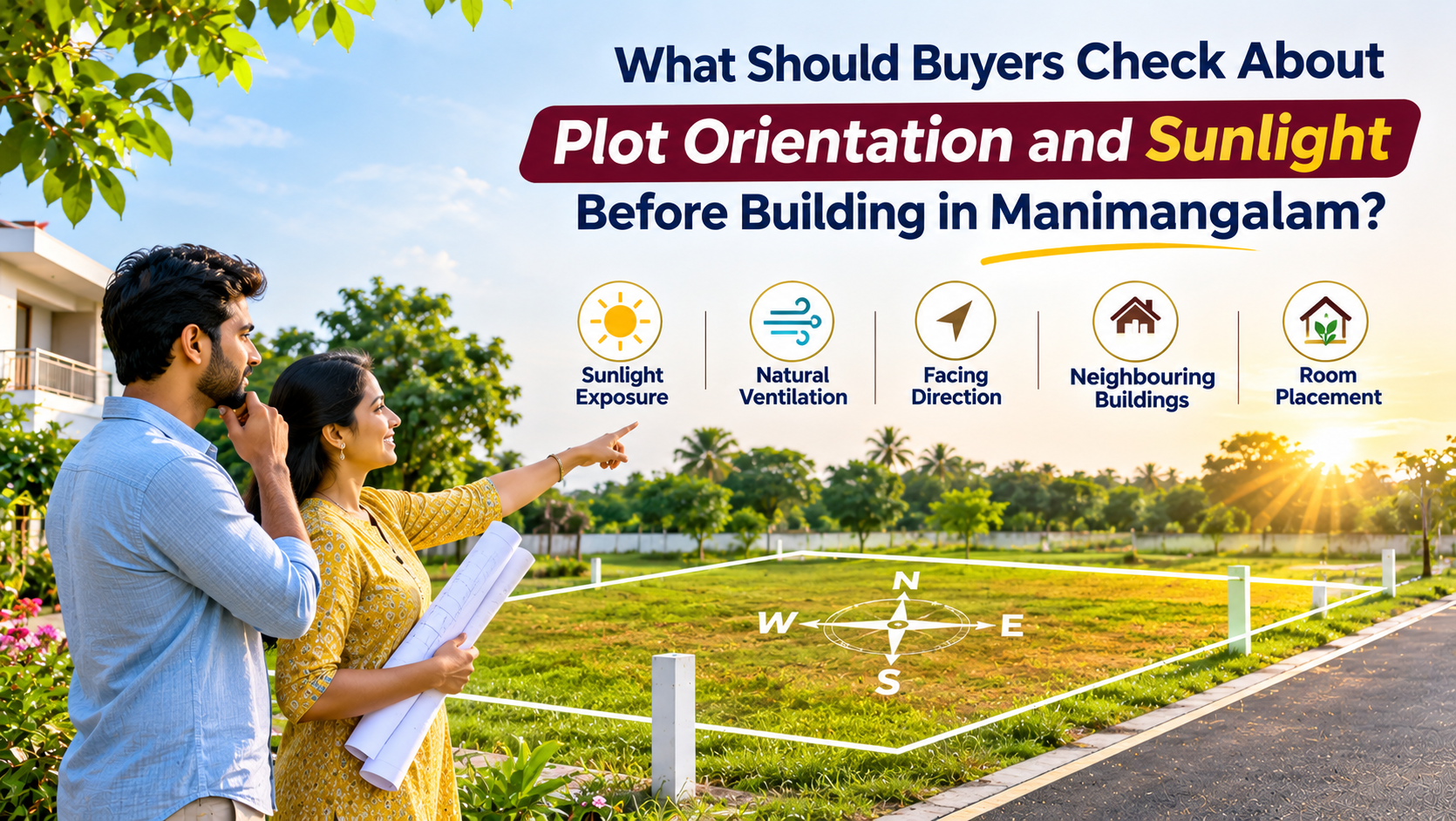
Buying a residential plot is not just about selecting the right location, size or budget. The direction a plot faces and the amount of sunlight it receives can also influence how comfortably a future home functions.
For buyers exploring residential plots in Manimangalam, understanding plot orientation is an important step before finalising a property or preparing a house construction plan.
The direction of the road-facing side, surrounding buildings, seasonal sunlight patterns and prevailing wind conditions can affect natural lighting, ventilation, indoor temperatures and the placement of rooms.
However, an east-facing or north-facing plot is not automatically better than a west-facing or south-facing plot. Every orientation has advantages and limitations, depending on the building design and surrounding environment.
This guide explains what buyers should check about plot orientation and sunlight before planning a residential home in Manimangalam.
Plot orientation generally refers to the direction a property faces, commonly identified by the side adjoining its access road or the direction of its main entrance.
Residential plots are often described as:
While these descriptions help buyers understand the property's position, they do not provide a complete picture of its suitability for construction.
For example, two east-facing plots within the same residential layout may receive different amounts of sunlight because of neighbouring buildings, trees, setbacks and proposed house designs.
Plot orientation matters because it can influence:
Before purchasing a plot, buyers should consider how its orientation will work with the home they intend to build.
Manimangalam is located in the Chennai region, where warm weather and strong sunlight make thoughtful building orientation particularly important.
Understanding the movement of the sun can help homeowners plan indoor spaces more comfortably.
The sun generally rises in the east, although its exact position changes throughout the year.
East-facing openings can receive useful morning sunlight, which may support natural lighting during the early part of the day.
However, the amount of sunlight entering a room also depends on the position and size of windows, nearby obstructions and shading.
West-facing walls and windows may experience substantial solar exposure during the hotter afternoon hours.
Without suitable shading, this can contribute to indoor heat gain.
Architectural features such as external shading devices, appropriate glazing, insulated roofs and carefully positioned openings can help manage this exposure.
The sun's path changes throughout the year.
Because Manimangalam is located at a relatively low northern latitude, sunlight exposure on north- and south-facing surfaces varies seasonally.
Therefore, buyers should not assume that a particular side of a plot will always remain shaded or sunny.
Practical tip: Visit the plot at different times of day and ask an architect to assess seasonal sun exposure before finalising the building design.
East-facing residential plots are often preferred by buyers who want their entrance or front-facing spaces oriented towards the morning sun.
However, the actual benefits depend on the layout of the house.
An east-facing plot may still have significant afternoon heat exposure on its western side.
If bedrooms, living rooms or large windows are positioned towards the west, suitable shading and ventilation planning may be necessary.
Buyers should also check whether neighbouring buildings obstruct morning sunlight.
Buyer consideration: An east-facing plot should be evaluated based on the complete house layout rather than entrance direction alone.
Some buyers hesitate to consider west-facing plots because of concerns about afternoon sunlight.
However, a well-designed home can manage western exposure effectively.
West-facing walls and windows may receive intense afternoon sunlight.
This can increase indoor temperatures if the building lacks suitable heat-control measures.
Homeowners can discuss the following design options with an architect:
Buyer consideration: A west-facing plot should not be rejected solely because of its orientation. Its dimensions, surroundings and proposed building design are equally important.
North-facing and south-facing plots can also offer practical opportunities for residential construction.
The suitability of either orientation depends on the placement of openings, the building's shape and seasonal sunlight conditions.
North-facing plots may provide opportunities for indirect natural light through appropriately positioned windows.
However, north-facing walls are not guaranteed to remain free from direct sunlight throughout the year in the Chennai region.
Buyers should assess the complete building design and surrounding obstructions.
South-facing plots can be designed with suitable shading, window placement and ventilation strategies.
Horizontal sunshades may help control certain high-angle sunlight conditions, while additional measures may be required for low-angle exposure.
Neither north-facing nor south-facing plots should be evaluated only by their directional label.
The most useful assessment considers the actual site and proposed house plan.
A site visit can help buyers understand the surrounding environment and identify potential sunlight obstructions.
When inspecting a residential plot in Manimangalam, observe the following:
Morning exposure: Check whether nearby buildings or trees block sunlight from the eastern side.
Afternoon exposure: Identify areas that receive strong western sunlight.
Neighbouring structures: Observe the height and position of existing buildings.
Vacant neighbouring plots: Consider the possibility of future construction affecting sunlight access.
Existing trees: Identify trees that provide shade without assuming they can be removed or altered.
Road orientation: Note how the road-facing side influences entrance and parking options.
A single visit may not reveal the full sunlight pattern.
If sunlight is an important factor in your purchase decision, arrange visits at different times or obtain a professional solar analysis.
Sunlight is only one aspect of residential comfort.
Natural ventilation also plays an important role in managing indoor air movement.
Cross-ventilation occurs when air can enter and exit through appropriately positioned openings, subject to wind conditions and pressure differences.
For buyers considering plots for sale in Manimangalam, it is useful to understand whether the proposed house can accommodate suitable openings.
Factors to consider include:
In the Chennai region, seasonal wind conditions change throughout the year.
Therefore, buyers should avoid assuming that wind will always enter from one direction.
A plot surrounded by closely spaced buildings may have fewer opportunities for effective natural airflow.
Similarly, a plot with more open space on multiple sides may offer additional design flexibility, although actual ventilation performance still depends on the building.
Practical tip: Ask your architect to assess natural ventilation opportunities using the site layout and local climate rather than relying only on the plot's facing direction.
The surrounding environment can significantly influence the amount of sunlight reaching a residential plot.
For example, a vacant plot may currently receive unobstructed sunlight.
However, future buildings on adjacent properties could create additional shading.
Before purchasing land, observe:
Buyers should not assume that neighbouring land will remain vacant.
It is also important to avoid relying on informal promises about future building heights or open spaces.
A qualified architect can help assess how surrounding development may affect the proposed home.
Two plots with the same facing direction may offer different design possibilities because of their dimensions.
For example, a wider plot may provide more flexibility in arranging windows and open spaces than a narrow plot of similar total area.
However, the actual outcome depends on the applicable setbacks and building regulations.
The width of the plot can influence:
The depth of the plot can affect:
Irregularly shaped plots may require more detailed planning to make efficient use of the available land.
Buyers should review the plot dimensions and consult an architect before assuming a particular house layout will fit.
Important: A favourable facing direction does not compensate for unsuitable dimensions or restrictions that prevent the desired building design.
Different rooms have different lighting and comfort requirements.
A thoughtful house design should consider how each space will be used throughout the day.
| Area | Sunlight and planning considerations |
|---|---|
| Living room | Comfortable daylight, glare control and ventilation |
| Bedrooms | Morning or evening heat exposure and privacy |
| Kitchen | Ventilation, daylight and heat management |
| Home office | Balanced daylight with minimal screen glare |
| Balcony | Sunlight exposure during intended usage hours |
| Parking | Access, turning space and vehicle shade |
| Staircase | Daylighting and safe ventilation |
| Utility area | Practical drying space and weather protection |
For example, a home office used during afternoon hours may benefit from carefully controlled daylight to reduce glare.
Similarly, bedrooms with substantial western exposure may require additional shading.
The ideal arrangement depends on household routines and the complete building design.
Plot orientation can indirectly influence household energy requirements.
A building exposed to excessive solar heat may require more cooling, particularly if insulation and shading are inadequate.
On the other hand, well-designed natural lighting may reduce the need for artificial lighting during daylight hours.
Factors affecting energy performance include:
However, plot orientation alone cannot reliably predict electricity bills.
A suitable building design can often improve energy performance across different plot orientations.
Buyers should consult an architect or building professional about passive cooling and energy-efficient design options.
Some buyers purchasing residential land may plan to install rooftop solar panels after construction.
If solar energy is part of the long-term plan, the roof design deserves early consideration.
Important factors include:
In the Chennai region, appropriately designed rooftop solar systems may be feasible on a variety of roof configurations.
However, the expected performance depends on actual roof conditions and system design.
Practical tip: If you intend to install rooftop solar panels, inform your architect before finalising the building plan.
Some residential plot buyers consider Vastu principles when selecting land or planning a home.
Preferences may include particular entrance directions or room arrangements.
These considerations can form part of a buyer's personal requirements.
However, Vastu preferences should be distinguished from measurable factors such as sunlight exposure, airflow, structural safety and compliance with building regulations.
If Vastu is important to your family, discuss those preferences with your architect while ensuring the building design also addresses:
A balanced approach can help buyers evaluate personal preferences alongside practical construction needs.
Before finalising a plot, consider asking the developer, seller or relevant professionals the following questions:
These questions can help buyers make a more informed decision.
For buyers planning to construct a home, choosing a suitable residential plot involves more than identifying a preferred facing direction.
Location, plot dimensions, access, surrounding development and future construction requirements should all be considered.
Sigaram Enclave by Premier Housing & Properties is a residential plot project in Manimangalam for buyers exploring land ownership and future home-building opportunities.
When evaluating a plot at Sigaram Enclave, review the available plot options and assess their orientation in relation to your proposed home design.
A site visit can help you observe road access, surrounding properties and the existing environment.
Before purchasing, independently verify the relevant layout approvals, title documents, measurements and other property details.
Consulting an architect before finalising a plot may also help identify whether its dimensions and orientation suit your family's requirements.
Explore Sigaram Enclave – Residential Plots in Manimangalam for project information and enquiries.
Before purchasing a residential plot in Manimangalam, review this checklist:
Plot orientation and sunlight are important considerations when planning a residential home, but they should not be evaluated in isolation.
For buyers exploring residential plots in Manimangalam, understanding how sunlight, ventilation, plot dimensions and neighbouring buildings influence future construction can help support a more informed purchase decision.
East-, west-, north- and south-facing plots can all offer practical opportunities when the house is designed according to the site's actual conditions.
The most suitable plot is one that meets your budget, documentation requirements, access needs and long-term home-building plans.
By inspecting the property carefully and consulting qualified professionals before construction, buyers can make better use of their residential land.
Explore your future home-building possibilities with Premier Housing & Properties.
Premier Housing & Properties
No 11, NRD Tower, 3rd Floor,
Jawaharlal Nehru Road,
Ashok Nagar, Chennai - 600 083.