
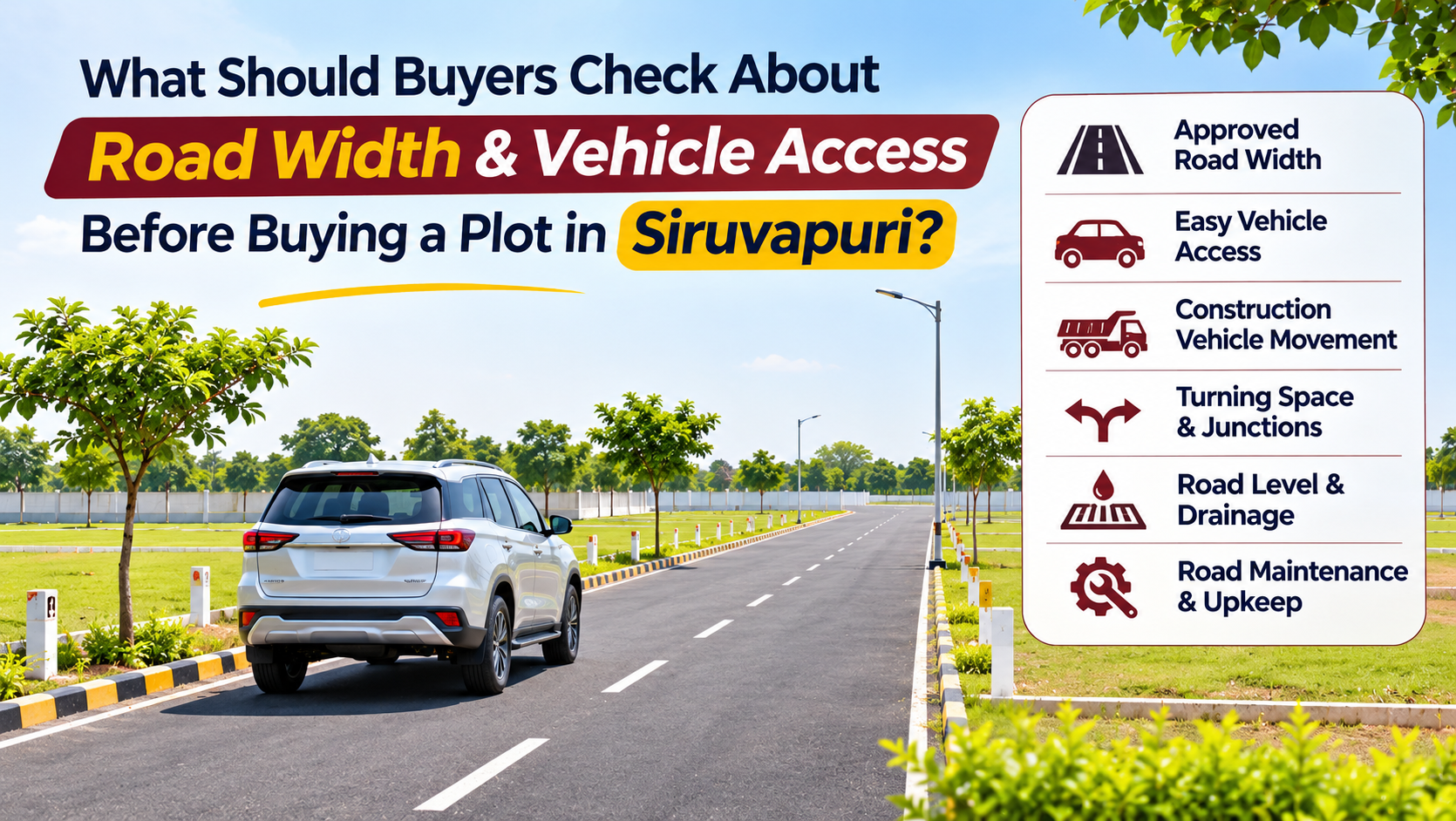
Buying a residential plot involves more than choosing a suitable location, budget and plot size. One important factor that buyers sometimes overlook is the road leading to the property.
For families exploring residential plots in Siruvapuri, road width and vehicle access can influence everyday convenience, parking arrangements, construction planning and long-term usability.
A plot may appear attractive during a site visit, but a narrow approach road, difficult turning point or obstructed entrance could create challenges after purchase.
Before booking a plot, buyers should understand how the surrounding roads connect to the property, whether vehicles can enter comfortably and whether the available access matches the approved layout.
This guide explains the important road width and vehicle access checks buyers should make before purchasing residential land in Siruvapuri.
Road width affects how easily residents, visitors and service vehicles can reach a property.
A road that accommodates two-wheelers may not always provide comfortable access for cars, delivery vehicles or construction equipment.
When evaluating plots for sale in Siruvapuri, buyers should consider how the road will function after houses are constructed and the neighbourhood becomes more occupied.
Important considerations include:
A road that appears sufficiently wide when the surrounding plots are vacant may feel more restricted once nearby properties are occupied.
Buyer tip: Evaluate the road based on future residential use, not only its present appearance.
One of the first checks buyers should make is comparing the road width shown in the approved layout plan with the conditions visible at the site.
An approved layout may specify road dimensions, but buyers should still verify the road's physical condition and usable width.
Ask the developer for the relevant approved layout plan and identify the road serving the selected plot.
Check:
For example, a road may have a specified width in the layout plan, while its currently usable driving surface may be narrower because of unfinished shoulders or drainage work.
This does not automatically indicate a violation, but it is a reason to request clarification.
Buyer tip: Do not assume that the visible driving surface represents the complete approved road width.
Road width and usable vehicle space are not always identical.
The total road corridor may include elements such as drains, shoulders or other infrastructure, depending on the approved design.
When assessing a residential plot, consider whether vehicles can move comfortably along the actual carriageway.
Observe:
A road may look wide when viewed from a distance but feel narrower when vehicles are parked on either side.
For buyers planning an independent house, the practical ability to enter and leave the property is often more useful than relying on a single width measurement.
Before purchasing land, think about the vehicles your household currently uses and may use in the future.
A family with one car and two two-wheelers will have different access requirements from a household planning to accommodate multiple cars.
During the site visit, assess:
If practical and permitted, observe a vehicle travelling along the approach road.
This can help identify issues that are not immediately obvious from photographs or layout drawings.
Buyer tip: Consider your future parking requirements before finalising the plot.
The location of the future entrance can influence how comfortably vehicles move between the road and the property.
Even where road access is adequate, a poorly positioned gate may make parking and vehicle entry inconvenient.
Before buying a plot, consider:
For example, a plot with limited frontage may require more careful planning to accommodate a car entrance and parking space.
A qualified architect can help evaluate whether the intended house layout and parking arrangements are practical for the selected plot.
Buyer tip: Review vehicle entry requirements during the plot-selection stage rather than waiting until construction begins.
Buyers planning to build an independent house should consider whether construction-related vehicles can reach the property.
During construction, different vehicles may be required to deliver materials or support building activities.
These could include:
The size of vehicles used will depend on the construction method, contractor and site conditions.
A narrow road or difficult turning point could require smaller vehicles or additional material handling.
This may affect construction logistics and expenses.
Before purchasing the plot, ask whether similar construction work has been carried out nearby and whether any access restrictions apply.
Buyer tip: Discuss construction vehicle access with a qualified contractor before finalising a plot if you plan to build soon.
Vehicle access depends not only on the road directly in front of the plot but also on the route leading to it.
A plot may face a reasonably wide internal road while the connecting junction is difficult for larger vehicles to navigate.
During a site visit, examine:
If the plot is located at the end of a road, check whether sufficient turning space is available.
For corner plots, assess how the junction and road alignment could influence future gate placement.
Buyer tip: Travel the complete route from the main connecting road to the selected plot instead of inspecting only the plot frontage.
Physical obstructions can affect vehicle movement even when the approved road width appears adequate.
Common examples include:
Not every obstruction indicates an encroachment. Some may be temporary or part of authorised infrastructure.
However, buyers should clarify any permanent structure that appears to interfere with the approved road alignment.
Where there is a concern about road boundaries or access rights, request relevant records and obtain professional verification.
Buyer tip: Avoid relying solely on verbal assurances that an obstruction will be removed later.
Emergency access is another important consideration when evaluating residential land.
Fire service vehicles, ambulances and other emergency vehicles may need to reach homes quickly.
The actual access requirements depend on the development, applicable regulations and vehicle characteristics.
Buyers should consider:
Do not assume that a particular road width automatically guarantees access for every emergency vehicle.
Where necessary, seek clarification from the relevant planning authority or qualified professional.
Buyer tip: Prioritise clear, practical road access rather than evaluating only the distance from the main road.
Road quality can influence vehicle access throughout the year.
A road that appears convenient during dry weather may become difficult to use after heavy rainfall if drainage or surface conditions are inadequate.
During the site visit, examine:
If possible, ask nearby residents about road conditions during the rainy season.
For buyers exploring residential plots in Siruvapuri, understanding seasonal access conditions can support more informed decisions.
Buyer tip: A well-formed road should be evaluated together with its drainage arrangements and surrounding ground levels.
Road access involves two separate considerations: movement within the residential layout and connectivity to surrounding roads.
Internal roads influence how easily residents can reach their individual plots.
External approach roads determine how the layout connects to nearby neighbourhoods and destinations.
Before buying, evaluate:
If a developer mentions future road improvements, request supporting information rather than treating the improvements as guaranteed.
Buyer tip: Base your purchase decision on verified existing connectivity, while treating proposed infrastructure as a separate consideration.
A road's physical condition is important, but buyers should also understand its legal and maintenance status.
Depending on the layout and applicable approvals, roads may be subject to different ownership, handover and maintenance arrangements.
Before purchasing, ask:
Where relevant, buyers can seek clarification from the appropriate local authority and arrange independent document verification.
Buyer tip: Do not assume that every internal road is automatically maintained by the local body.
A residential layout may look quiet when only a few plots have been developed.
As more houses are constructed, vehicle movement and parking demand can increase.
Consider how the roads may function when:
This does not mean buyers should avoid developing residential neighbourhoods.
Instead, they should evaluate whether the layout and its road network appear suitable for expected residential activity.
Buyer tip: Assess road convenience based on the neighbourhood's potential future use, not just present traffic conditions.
For buyers considering residential land in Siruvapuri, road width and vehicle access should be part of the property evaluation process.
A suitable plot should support not only the intended house design but also convenient access for residents, visitors and construction-related activities.
Velan Nagar by Premier Housing & Properties is a residential plot project in Siruvapuri for buyers exploring land ownership and future home-building opportunities.
When considering a plot at Velan Nagar, review the selected plot's location within the layout and request the relevant approved road details.
During a site visit, examine the internal roads, approach route, plot entrance and surrounding conditions.
Buyers should independently verify the applicable approvals, access arrangements and property documentation before making a purchase commitment.
Explore Velan Nagar – Residential Plots in Siruvapuri for project information and enquiries.
Before purchasing a residential plot in Siruvapuri, use this checklist:
Road width and vehicle access are important factors when choosing residential land for future home construction.
For buyers exploring residential plots in Siruvapuri, evaluating the approved road dimensions, practical vehicle movement, entrance arrangements, construction access and road conditions can help avoid unexpected difficulties.
A thorough site visit should include the entire approach route, not just the selected plot.
Buyers should also clarify road maintenance responsibilities and independently verify relevant layout documents before making a financial commitment.
Careful evaluation of these details can help families select a plot that supports everyday convenience and long-term residential needs.
Explore residential plot opportunities in Siruvapuri with Premier Housing & Properties.
Premier Housing & Properties
No 11, NRD Tower, 3rd Floor,
Jawaharlal Nehru Road,
Ashok Nagar, Chennai - 600 083.