
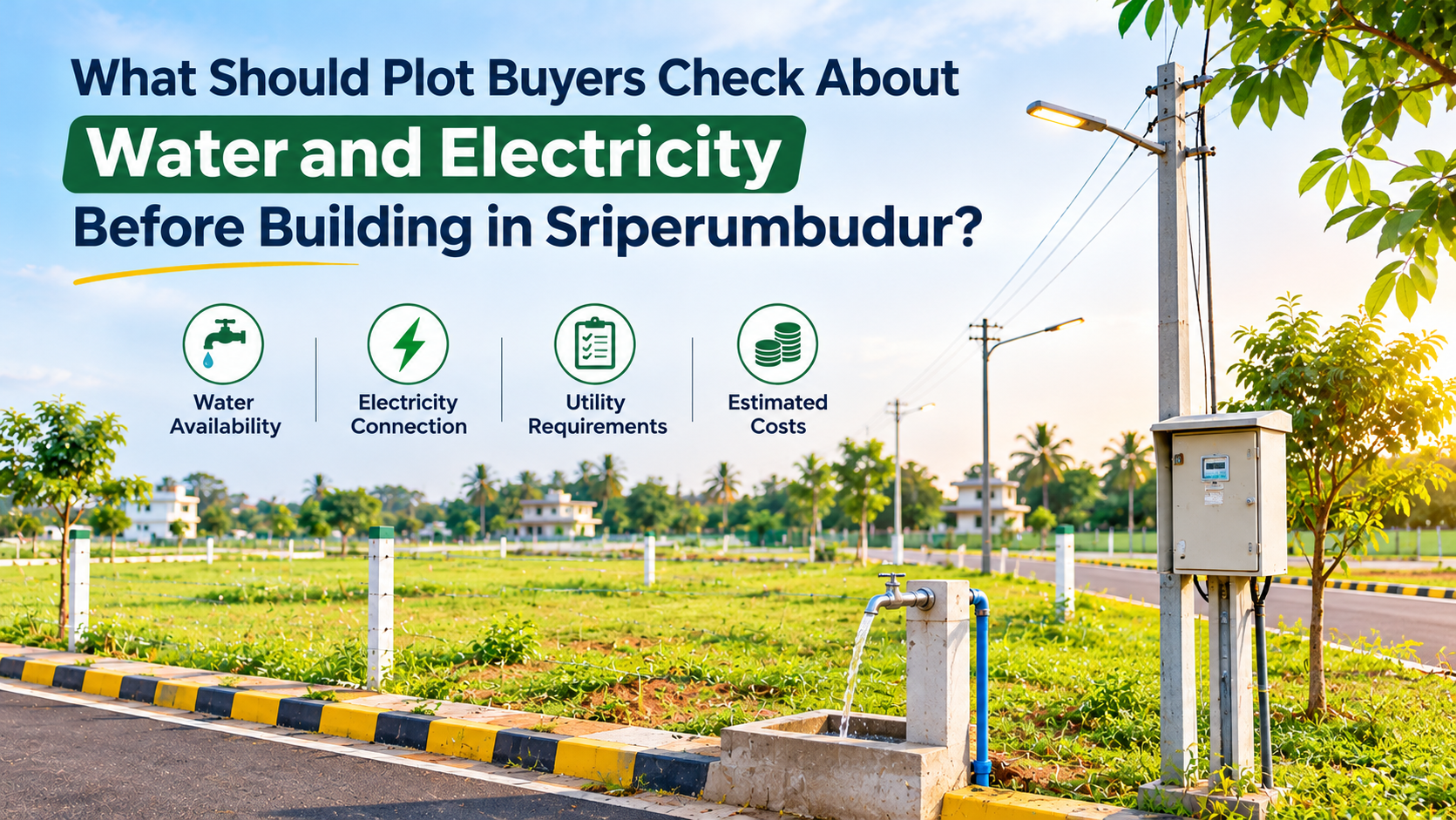
Buying a residential plot is an important step towards building your own home. While location, plot size, road access and legal approvals are usually the first things buyers consider, two essential factors deserve equal attention: water availability and electricity infrastructure.
For families exploring residential plots in Sriperumbudur, understanding how these utilities can be accessed is particularly important when planning to construct a house in the future.
A residential layout may have streetlights, nearby electricity poles or an existing water facility. However, these features do not automatically confirm that every plot has an individual electricity connection or a dependable water supply for a completed home.
Checking these details before purchasing land can help buyers plan their construction budget, avoid unexpected delays and make informed decisions.
This guide explains the important water and electricity checks to consider before buying residential land in Sriperumbudur.
A residential plot may remain vacant for several months or years before construction begins. During this period, the surrounding infrastructure and availability of essential utilities can influence future building plans.
Water is required for construction activities and everyday household use. Electricity is necessary for lighting, appliances, water pumps and other essential residential requirements.
Before finalising a plot, buyers should understand:
These checks help buyers assess the practical readiness of a residential plot rather than relying only on its appearance or advertised features.
One of the first things to observe during a site visit is the availability of electricity infrastructure.
Look for existing electricity poles, distribution lines, transformers and electrical connections serving nearby properties.
However, the presence of an electricity pole does not guarantee that a new connection can be provided immediately.
Actual feasibility depends on factors such as network capacity, technical requirements, property documentation and the applicable procedures of the electricity distribution utility.
When inspecting residential plots in Sriperumbudur, buyers can ask:
For accurate information, buyers should confirm the requirements with the relevant local electricity distribution office.
Street lighting is a useful feature in a residential layout, particularly for visibility and movement after dark.
However, streetlights and individual residential electricity connections serve different purposes.
Streetlights are generally part of public or common-area infrastructure, while a household connection supplies electricity to a specific property.
A layout with functioning streetlights may still require individual plot owners to apply separately for electricity service when constructing their homes.
Before purchasing a plot, clarify whether:
This distinction helps prevent confusion between the facilities available within a layout and the services required for an individual home.
For residential properties in Tamil Nadu, electricity service connections are handled through the applicable electricity distribution utility under current regulations and procedures.
Buyers planning future construction should understand the broad application process in advance.
Depending on the type of connection, applicants may need to provide relevant ownership, identity, address, building or other supporting documents.
The exact requirements can vary according to the connection category and prevailing regulations.
Before construction, consider checking:
Avoid assuming that a residential connection will be available immediately after plot registration.
Consult the electricity distribution utility for current requirements and charges before making financial commitments.
Electricity may be required even before a home is completed.
Construction activities can involve equipment such as drilling machines, cutting tools, lighting systems and water pumps.
Depending on the construction method and contractor's arrangements, a temporary electricity supply may be necessary.
Before beginning construction, discuss the following with your contractor:
Temporary and permanent connections may have different requirements.
Buyers should not assume that an existing nearby connection can be used for construction without the necessary authorisation.
Planning these requirements early can reduce interruptions during the building process.
Water availability is another important consideration when buying land for future residential construction.
In and around Sriperumbudur, water arrangements can differ between locations and residential developments.
Possible sources may include groundwater, approved piped-water connections, community water facilities or authorised tanker supply.
However, the availability of any particular source should be verified for the specific property.
During a site visit, ask:
Avoid assuming that the presence of a borewell or water tank in a layout guarantees sufficient water for every future household.
The source, capacity, reliability and applicable permissions should be checked separately.
Groundwater is an important consideration for some residential properties, but its availability and quality can vary significantly over short distances.
The presence of a functioning borewell on a neighbouring property does not guarantee that another plot will have the same groundwater conditions.
Before planning a borewell, buyers should consider obtaining professional advice about local groundwater conditions and applicable permissions.
Important considerations include:
Water that looks clear is not necessarily safe for drinking.
Where groundwater is proposed for domestic use, appropriate laboratory testing can help identify relevant quality concerns.
Testing requirements may include parameters such as dissolved solids, hardness, microbial contamination and other factors recommended by a qualified laboratory.
Any drinking-water treatment system should be selected based on actual test results rather than assumptions.
Water is essential during several stages of residential construction.
It may be required for concrete work, curing, masonry, plastering, cleaning and other activities.
The quantity and quality of water required depend on the building design, construction methods and materials used.
Before beginning construction, ask your contractor:
Water quality can affect certain construction materials and processes.
Where necessary, the contractor or engineer should assess whether the proposed water source is suitable for the intended construction work.
Planning water arrangements early helps avoid delays and unplanned expenditure.
Construction-stage water requirements are temporary, but household water needs continue after the home is occupied.
When evaluating residential plots in Sriperumbudur, buyers should consider how water may be supplied and stored in the completed house.
Future requirements may include:
The appropriate design depends on household size, water availability, building layout and applicable regulations.
Rainwater harvesting can form part of responsible water management, but it should not automatically be treated as a complete substitute for a dependable domestic water supply.
Discuss the proposed water system with a qualified building professional during the design stage.
Electricity and water arrangements can influence how a house is designed.
For example, the position of electricity poles, overhead lines, water pipelines and drainage infrastructure may affect construction planning.
Before purchasing a plot, observe whether any visible utility infrastructure crosses or borders the property.
Important questions include:
Do not relocate poles, interfere with pipelines or modify public infrastructure without the required authorisation.
Where electrical lines or other infrastructure could affect the proposed building, consult the relevant utility and a qualified engineer.
Understanding these conditions before construction can help buyers make better design decisions.
The advertised price of a residential plot is not necessarily the complete cost of preparing it for construction.
Depending on existing infrastructure and connection requirements, additional expenses may arise.
These could include:
| Expense category | Possible requirement |
|---|---|
| Electricity connection | Application charges, deposits and approved installation work |
| Electrical infrastructure | Additional work if required by the utility |
| Temporary electricity | Construction-stage connection and usage charges |
| Water connection | Applicable connection and installation expenses |
| Water storage | Underground or overhead tanks |
| Water pumping | Pump, controls and associated plumbing |
| Water testing | Laboratory assessment where necessary |
| Water treatment | Filtration or treatment based on test results |
| Construction water | Approved tanker or other temporary supply arrangements |
These are possible expense categories, not confirmed charges for a particular project.
Actual costs depend on the property, connection category, current utility regulations and technical feasibility.
Obtaining written information or estimates from the relevant providers can help buyers prepare a more realistic budget.
When evaluating a residential layout, buyers should ask specific questions rather than relying on broad descriptions such as "water facility" or "electricity available".
Useful questions include:
Request supporting details where appropriate.
A clear understanding of existing facilities and future responsibilities can help buyers distinguish between a layout's general infrastructure and the arrangements required for their individual homes.
A physical site visit can provide useful information about the surrounding infrastructure.
When visiting a residential plot in Sriperumbudur, observe the condition of internal roads, visible electrical installations, nearby houses and available access.
If neighbouring homes are occupied, their presence may help buyers identify questions about utility arrangements.
However, buyers should not assume that services available to one property will automatically be available to another.
It can also be helpful to visit the area at different times or after significant rainfall to understand the general site conditions.
Record any concerns and seek clarification from the relevant developer, authority or utility provider before making a purchase decision.
For buyers planning to build a home in the future, choosing a residential plot involves evaluating both the land and the practical requirements of construction.
Professors Township by Premier Housing & Properties is a residential plot project in Sriperumbudur for buyers exploring land ownership and future home-building opportunities.
When considering a plot at Professors Township, review the project's current infrastructure details, layout documentation, plot dimensions and available facilities.
Buyers should independently confirm the status of water facilities, street lighting, electricity infrastructure and individual utility connection requirements.
The presence of shared facilities should not be interpreted as confirmation that separate household connections are already available.
Explore Professors Township – Residential Plots in Sriperumbudur to learn more about the project and enquire about available plots.
Before finalising your purchase, use this practical checklist:
Water and electricity are essential considerations when purchasing residential land for future home construction.
For buyers exploring residential plots in Sriperumbudur, checking utility infrastructure before registration can help identify potential expenses, clarify connection responsibilities and support better construction planning.
A well-informed purchase decision involves more than checking whether electricity poles or water facilities are visible near the property. Buyers should understand the actual availability, connection procedures, technical requirements and long-term reliability of these services.
By verifying these details early, families can approach their future home-building plans with greater clarity and confidence.
Explore your residential plot options in Sriperumbudur with Premier Housing & Properties.
Premier Housing & Properties
No 11, NRD Tower, 3rd Floor,
Jawaharlal Nehru Road,
Ashok Nagar, Chennai - 600 083.